
Hard Hats, History and Hidden Treasures: Coventry Society Visits The Chace

There are heritage visits… and then there are heritage visits involving scaffolding, stained glass, unexpected architectural discoveries and the distinct feeling that Coventry is quietly getting one of its grandest buildings back.
This week, The Chace welcomed John Payne and David Fry of the Coventry Society to see first-hand the progress being made on the restoration of this remarkable Grade II listed building.
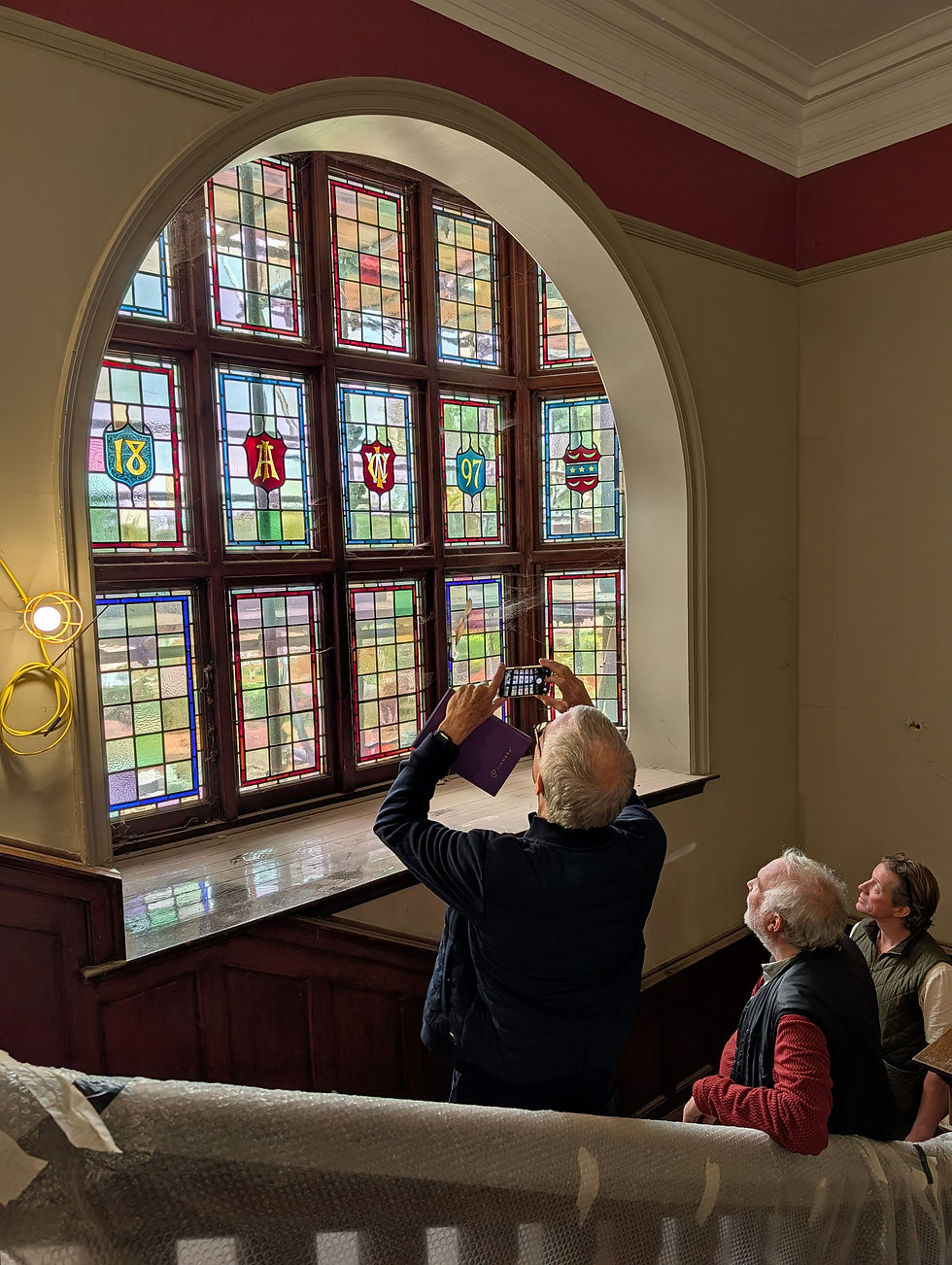
The pair toured the site alongside the project team, climbing through what can only be described as an impressive forest of scaffolding to inspect roof works, exterior repairs and — perhaps most excitingly — many of the original internal features that have survived decades of changing ownership and use.
And survive they have.
Original stained glass windows still cast coloured light across interiors. Timber detailing remains. Architectural flourishes continue to reveal the confidence (and perhaps a little ego) of the man who built the place. Walking through parts of The Chace today, even mid-restoration, you begin to understand why so many Coventrians have long hoped someone would give this building another chapter.
A House Built to Impress
Long before becoming a hotel, The Chace was built in 1897 as the private residence of Dr Charles Webb Iliffe — Coventry coroner, civic figure and prominent local personality.
Designed as an impressive late-Victorian home, the building reflected status, ambition and craftsmanship. Its dramatic half-timbered façades, decorative detailing and generous interiors were intended to make a statement.
Mission accomplished.
Following Dr Iliffe’s death, the house became The Chace Hotel in the early 1930s, beginning nearly ninety years as a place for weddings, celebrations, conferences, Sunday lunches and countless Coventry memories.
After closure and years of uncertainty, the building was awarded Grade II listed status in 2023, recognising both its architectural significance and historic importance to Coventry. Historic England highlighted not only the quality of the design but also the unusually high survival of original internal features.
That survival is exactly what visitors this week were able to witness.
Champions of Coventry’s Heritage
The visit felt particularly fitting given who was touring.
John Payne has served as a trustee of the Coventry Society for many years and has long been involved in protecting and promoting the city’s heritage.
David Fry, also a Coventry Society trustee, is well known among local historians for his extensive research into Coventry’s past and his remarkable archive of historical photographs and postcards. His enthusiasm for local history is widely recognised.
The Coventry Society, founded in 1970, exists to campaign for and support the protection of Coventry’s historic environment. For decades, the Society has spoken up for buildings whose stories might otherwise have been lost.
So when two people who have spent years defending Coventry’s architectural legacy stand beneath newly restored roofs and admire surviving stained glass, it matters.
Heritage Inspection… or Adventure Sport?
The photographs suggest the visit occasionally bordered on an expedition.
Negotiating scaffold walkways several storeys high while discussing conservation details requires a particular kind of confidence. Fortunately, curiosity appeared stronger than caution.
Outside, conversations focused on the scale of works underway and the extraordinary complexity of restoring a building that has evolved repeatedly over more than 125 years.
Inside, attention turned to the details that give listed buildings their soul: craftsmanship, materials, windows, proportions and the small surviving touches modern buildings rarely possess.
The mood was optimistic.
Because restoration projects like this are rarely only about bricks and roofs.
They are about memory.
Coventry’s Next Chapter
For years The Chace sat in an uncertain place — too important to lose, too complex to rescue easily. Plans came and went. Futures were imagined and abandoned.
Now, standing beneath scaffolding with original features emerging rather than disappearing, a different future starts to feel possible.
Not nostalgia.
Renewal.
The hope is that The Chace once again becomes a place people know, visit, celebrate in and talk about — while retaining the character that made it special in the first place.
Coventry has lost enough heritage over the decades to know the value of saving what remains.
Watching John Payne and David Fry explore the building, pausing over details that have endured for generations, there was a quiet sense that this old house on London Road is preparing for another long life.
And Coventry may soon get one of its gems back.
The restoration of The Chace continues, revealing not only the craftsmanship of the past but also the exciting possibility of a new future for one of Coventry’s most distinctive historic buildings.


I love seeing the updates! We got married at the chace in Sept 2017 and used to stay every year on our anniversary. Gutted when it closed! Looking forward to coming back when it reopens to celebrate our anniversary again :)